
The Definitive Guide to Upstream Marketing
Strategic Framework for Growth and Differentiation
Most marketing performance problems are not execution problems.
They are strategy problems.
Organizations invest heavily in advertising, digital marketing, content, and sales enablement — and still struggle to grow. The issue is rarely a lack of effort downstream. It is a lack of clarity upstream.
Upstream marketing addresses the foundational decisions that determine how organizations compete, differentiate, and grow — before tactical execution begins. It is the strategic work that makes downstream execution worth doing.
This guide explains what upstream marketing is, why it matters, how it works, and how to apply it to your business. For a complete overview of the framework, download Upstream Marketing: An Overview.
What Is Upstream Marketing?
 Upstream marketing is a strategic approach focused on defining the right customers, the right opportunity spaces, and the right value proposition before committing to products, campaigns, or go-to-market programs.
It is not a traditional strategy or process. It is a set of principles, framing questions, and integrated practices that — when applied consistently — give organizations a structural advantage over competitors who lead with execution.
Upstream marketing decisions include:
- Which customer segments to prioritize — and which to walk away from
- Where the most valuable unmet needs exist in the market
- How to position the brand or offering for meaningful differentiation
- What value proposition will resonate most deeply with target customers
- Which innovation opportunities are worth pursuing
- How to align the organization around a coherent growth direction
- What the go-to-market model should look like before execution begins
Downstream marketing — advertising, SEO, CRM, content, campaigns — executes against those decisions.
Both matter. But downstream execution is only as strong as the upstream strategy behind it.
Upstream vs. Downstream: Understanding the Difference
The water in a river flows downstream. But the water’s direction, volume, and quality are determined upstream.
The same principle applies to marketing.
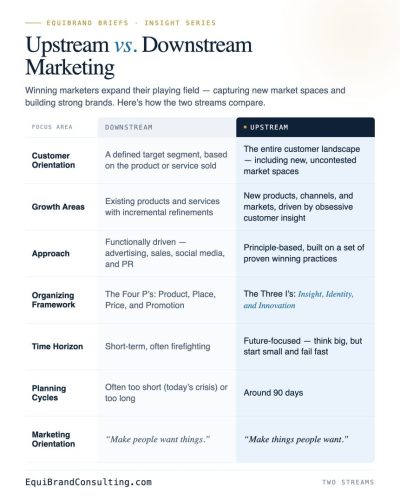 Downstream marketing = Tactics and execution
- Campaigns, advertising, content creation
- Digital channels, social media, email
- Conversion optimization, analytics
- Campaign management and performance measurement
Upstream marketing = Strategic direction
- Customer insight and segmentation
- Value proposition and positioning
- Brand identity and architecture
- Innovation strategy and opportunity identification
- Portfolio planning and go-to-market alignment
Most organizations have strong downstream capabilities. They can create campaigns. They can manage channels. They can optimize performance.
What they lack is upstream clarity.
The Problem: Surrender Marketing
There is a pattern that shows up repeatedly in organizations that are investing more in marketing but growing less. EquiBrand calls it Surrender Marketing.
Surrender marketing is what happens when an organization gradually hands control of its growth strategy to execution systems — optimizing campaigns, chasing algorithms, producing more content — without ever fully clarifying the upstream decisions that make any of it work.
It is not a failure of effort. It is a failure of strategic clarity.
The symptoms are recognizable:
- Marketing spend increases but growth does not follow
- The brand looks busy but does not stand for anything distinctive
- Campaigns perform in isolation but do not build toward a coherent position
- Innovation activity is high but adoption is low
- AI tools accelerate content production without improving strategic impact
- Every quarter brings new tactics, but the underlying positioning never changes
- Resources spread across too many initiatives without clear prioritization
Surrender marketing is the natural result of leading with downstream execution before upstream decisions are clear.
The organization gradually surrenders strategic control to the execution machine. Marketing becomes reactive. The brand message fragments. Resources scatter. Growth becomes unpredictable.
The antidote is not better execution. It is upstream strategic clarity — knowing who you serve, what you stand for, and why that matters to the customers you are trying to reach.
Why Upstream Marketing Matters Now More Than Ever
The companies that grow consistently share a common trait: they make better upstream decisions than their competitors.
They know which customers to serve. They have a clear point of view on differentiation. They innovate in ways that connect to real customer needs. And they align their organizations around a coherent strategy before investing in execution.
In an era where AI is commoditizing downstream execution, upstream strategic clarity is becoming the primary source of competitive advantage.
AI can generate content. It can optimize media. It can automate campaigns. It can even personalize customer experiences at scale.
What AI cannot do:
- Determine where to compete
- Identify which customers matter most
- Understand what unmet needs exist in your market
- Create differentiation that competitors cannot easily replicate
- Align an organization around a coherent growth strategy
Those decisions remain fundamentally strategic. And the organizations that get them right will increasingly outperform those that do not.
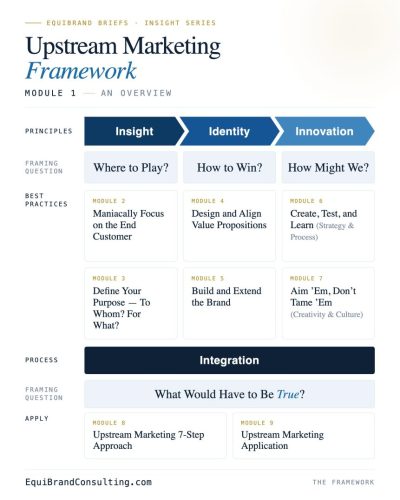
The Upstream Marketing Framework: Three Interconnected Principles
The upstream marketing framework is built around three interconnected principles — Insight, Identity, and Innovation — that work together to drive sustainable growth.
Each principle reinforces the others. When applied in combination, their effect is magnifying, not additive.
Principle 1: Insight
Growth begins with knowing something your competitors do not.
Upstream marketing is built on deep, proprietary customer insight — not surface-level data, but a genuine understanding of what customers need, why they behave the way they do, and where unmet opportunities exist.
Insight informs every downstream decision:
- Which segments to prioritize
- What value to offer
- How to position the brand
- Where to innovate
- How to allocate resources
Without insight, strategy is guesswork.
Effective insight development combines:
- Customer research and behavioral observation — Direct understanding of what customers do, say, and need
- Market and competitive analysis — Understanding the competitive landscape and where opportunities exist
- Segmentation and demand space mapping — Identifying which customer groups represent the greatest opportunity
- Strategic hypothesis development and testing — Creating and validating strategic assumptions before major investment
The most powerful competitive advantage is knowing what your customers need before they articulate it, or even before they know it themselves.
For a deeper dive into customer insight development, download Maniacally Focus on the Customer.
Principle 2: Identity
Identity is how an organization creates and communicates differentiated value.
It is the answer to the customer’s question: Why this brand, and not another?
Strong identity goes beyond a tagline or visual system. It defines:
- Positioning — The differentiated place the brand occupies in customers’ minds
- Value proposition — The specific value delivered to target customers
- Brand architecture — How offerings are organized and relate to each other
- Customer experience — How every touchpoint reinforces the brand promise
Identity must be:
- Distinctive — Different from competitors in a way that matters to customers
- Defensible — Rooted in real organizational capabilities and customer insight
- Aligned — Consistent across all customer touchpoints and internal operations
Many organizations confuse identity with brand aesthetics — logo, color palette, visual style. While these are expressions of identity, they are not identity itself.
True identity is strategic. It determines where the organization competes, which customers it serves, what value it creates, and how it differentiates.
For comprehensive guidance on building brand identity, download Build the Brand.
Principle 3: Innovation
Upstream innovation is not a product development function. It is a strategic discipline.
It is focused on identifying where new value can be created — and building the organizational capability to create it consistently.
Leading organizations do not wait for the market to force innovation. They:
- Identify unmet needs upstream through customer research and market analysis
- Explore new demand spaces before competitors recognize them
- Build innovation systems that generate a continuous stream of growth opportunities
- Align innovation with overall strategy rather than pursuing ideas in isolation
The difference between successful and unsuccessful innovation often has little to do with the quality of the idea. It has to do with whether the innovation is grounded in real customer needs and aligned with organizational strategy.
An innovation that solves a problem nobody has is not innovation. It is waste.
The three principles work together: Insight identifies where innovation is needed. Identity determines which innovations fit the strategic position. And sustained innovation creates new sources of differentiation and growth.
To develop a structured approach to innovation strategy aligned with upstream thinking, download Innovation Strategy Process and Aim ‘Em, Don’t Tame ‘Em: Creativity & Culture.
The Four Strategic Framing Questions
Upstream marketing engagements are structured around four framing questions that help leadership teams clarify direction and establish strategic priorities before execution begins.
Question 1: Where to Play?
Which customer segments, markets, channels, and opportunity spaces should receive strategic focus?
This question forces prioritization — the discipline of choosing where to compete, which implicitly defines where not to compete.
Most organizations try to be everything to everyone. They serve multiple customer segments, pursue multiple markets, and invest across multiple channels. The result is diluted positioning and fragmented resources.
Strategic organizations choose. They decide which segments represent the greatest opportunity, which markets to prioritize, which channels to emphasize. This focus creates the conditions for differentiation.
“Where to play” answers these questions:
- Which customer segments should we prioritize?
- Which unmet needs are we best positioned to address?
- Which markets or geographies should be the focus?
- Which channels will be most effective?
- What is our addressable opportunity?
Without clarity on where to play, all downstream decisions lack strategic anchor.
For detailed guidance on customer prioritization and segmentation, download Define Your Purpose: To Whom? For What?.
Question 2: How to Win?
Given a chosen opportunity space, how will the organization create differentiated value?
This is the positioning question — what makes the offering better, different, or more relevant than alternatives in a way that target customers will choose and pay for.
Many organizations assume they can win through operational excellence, lower cost, or feature superiority. While these factors matter, they do not create sustainable competitive advantage. Competitors can copy features, match prices, and improve operations.
True differentiation comes from creating value that competitors cannot easily replicate — either because it requires capabilities competitors do not have, or because it is rooted in a customer insight competitors have not discovered.
“How to win” requires:
- A clear value proposition — The specific value delivered to target customers
- Defensible differentiation — Why customers should choose this offering vs. alternatives
- Strategic positioning — The distinct place occupied in customers’ minds
- Organizational alignment — Internal operations and capabilities that support the positioning
Organizations that win clearly answer the question: What value do we create that competitors do not?
To develop a resonant value proposition aligned with target customers, download Design and Align Value Propositions.
Question 3: How Might We?
A forward-looking innovation question that challenges the organization to explore new possibilities.
This question operates at a different level than “Where to play” and “How to win.” It is about recognizing that the current strategy, while clear, is not static.
“How might we” surfaces new opportunities:
- How might we serve adjacent customer segments?
- How might we create new value for existing customers?
- How might we extend into new markets?
- How might we build new capabilities?
It is a discipline of challenging assumptions and exploring possibilities without committing to them immediately.
Question 4: What Would Have to Be True?
Connects strategic ambition to operational and market reality.
Before committing to a strategic direction, this question surfaces the conditions — financial, organizational, competitive, and market-related — that would need to hold for the strategy to succeed.
This is a discipline of honest assessment before major investment.
“What would have to be true” questions include:
- What would customer demand need to look like?
- What organizational capabilities would we need to build?
- What would competitive conditions need to be?
- What financial performance would be required?
- What market changes would need to occur?
Organizations that answer this question honestly avoid pursuing strategies that are strategically sound but operationally impossible.
Upstream Marketing in Practice: Real-World Examples
The principles of upstream marketing are visible in the strategies of the world’s most consistently successful companies. What distinguishes them is not superior execution — it is superior upstream decision-making.
Amazon
Upstream insight: Customers want selection, low prices, and convenience.
Upstream decision: Build an organization that could deliver on that insight at scale.
Every downstream innovation — Prime, AWS, Alexa, cashierless stores — flows from that upstream clarity. Amazon does not pursue ideas that do not connect back to that core insight. The company relentlessly prioritizes customer experience and operational efficiency, because those are what upstream thinking demanded.
Apple
Upstream positioning: Simplicity and integration.
Apple defined this positioning upstream, long before any product launch or campaign. The company created products because the positioning demanded it, not the other way around. Every downstream decision — from product design to retail experience to advertising — reinforces what was decided upstream.
Nike
Upstream identity: Athlete aspiration, not product features.
Nike built its identity around what athletes aspire to, not the features of shoes. That upstream identity decision shapes everything from product development (design for athletes) to advertising (celebrate athletic achievement) to retail experience (inspiration and performance focus).
Southwest Airlines
Upstream strategic choice: Compete on low-cost simplicity and operational efficiency.
Every downstream touchpoint is an expression of that upstream strategy. The airline chose its routes based on this positioning. It chose its aircraft. It chose its customer service model. It chose its compensation structure. All downstream decisions flowed from upstream strategy.
Starbucks
Upstream concept: The “third place” — a positioning around experience and emotional connection, not coffee.
Starbucks did not compete on coffee quality. It competed on creating an experience and emotional connection. That upstream decision shaped downstream programs like loyalty and seasonal campaigns — all activating that upstream identity.
The Upstream Marketing Process: Seven Steps
The upstream marketing framework is operationalized through a seven-step process that moves organizations from strategic clarity to execution alignment.
Step 1: Develop Customer Insight
Conduct deep research to understand customer needs, behaviors, decision-making processes, and unmet opportunities. This is not demographic analysis. It is understanding what customers actually care about and why.
Deliverable: Customer insight framework and segmentation
Step 2: Define Your Purpose
Segment customers based on insight. Prioritize which segments represent the greatest opportunity. Define your purpose: “To whom? For what?”
Deliverable: Customer segmentation and prioritization
Step 3: Develop Your Value Proposition
Define the specific value you deliver to target customers. How is this value different from competitors? Why should target customers care?
Deliverable: Validated value proposition
Step 4: Build Your Brand
Translate positioning and value proposition into brand identity, messaging, and experience. Define brand architecture if applicable.
Deliverable: Brand positioning, messaging, and architecture guidelines
Step 5: Define Your Portfolio
Decide which offerings serve which segments. Eliminate redundancy. Create clarity on how offerings relate to each other.
Deliverable: Portfolio strategy and organization
Step 6: Identify Innovation Opportunities
Based on customer insight and strategic positioning, identify where new value can be created. Develop innovation strategy that aligns with overall positioning.
Deliverable: Innovation strategy and opportunity pipeline
Step 7: Align Go-to-Market
Ensure go-to-market strategy (channels, messaging, sales approach, customer experience) aligns with upstream decisions. Do not pursue go-to-market decisions before upstream clarity.
Deliverable: Go-to-market strategy and execution roadmap
For a detailed walkthrough of this process, download The 7-Step Upstream Marketing Process.
When Organizations Need Upstream Marketing
Organizations often pursue upstream marketing when experiencing specific challenges that execution alone cannot solve:
- Growth slowing despite increased marketing investment
- Positioning that feels generic — the brand does not stand for anything distinctive
- Innovation that fails to drive adoption — good ideas that do not resonate in market
- Fragmented brand portfolios — offerings that overlap or compete internally
- Go-to-market execution that feels reactive — responding to competition rather than leading
- Resource fragmentation — budget spread across too many initiatives without clear prioritization
- Leadership misalignment — different executives have different views on strategy
- Organizational confusion — employees do not understand what the company stands for or who it serves
The Upstream Strategy Diagnostic is a structured assessment designed to help leadership teams identify which of these gaps is limiting performance and establish a stronger foundation for growth.
To explore how upstream marketing applies specifically to your business situation, download Upstream Marketing Application.
Frequently Asked Questions
What is the difference between upstream and downstream marketing?
Upstream marketing defines strategic direction — who to serve, how to differentiate, where to compete, and what to offer. Downstream marketing executes against those decisions through advertising, digital marketing, SEO, CRM, promotions, and sales programs. Both matter, but downstream execution is only as effective as the upstream strategy behind it.
What is Surrender Marketing?
Surrender Marketing is the pattern that emerges when organizations over-invest in downstream execution while underinvesting in upstream strategic clarity. The result is increased marketing activity without increased differentiation — more spend, more content, more campaigns, but no stronger position in the market. The organization gradually surrenders strategic control to the execution machine.
Is upstream marketing more important than downstream marketing?
Both are essential. But in an era where AI is commoditizing downstream execution, upstream strategic clarity is becoming the primary source of sustainable competitive advantage. More execution does not compensate for weak strategy.
What are examples of upstream marketing activities?
Customer segmentation and prioritization, market opportunity identification, value proposition development, brand positioning, innovation strategy, portfolio planning, go-to-market alignment, and organizational strategy development.
How do I know if my organization needs upstream marketing?
Common signals include growth slowing despite increased marketing investment, positioning that feels generic, innovation that fails to drive adoption, fragmented brand portfolios, and go-to-market execution that feels reactive. The Upstream Strategy Diagnostic helps leadership teams identify the specific strategic gaps limiting performance.
Can upstream marketing be done without outside consultants?
Possibly, but outside perspective often helps. Leadership teams are often too embedded in operational details to step back and challenge strategic assumptions. External guidance can accelerate clarity and rigor.
What is the first step in upstream marketing?
Usually: clarity on customer segments and unmet needs. This foundation informs all downstream strategic and execution decisions. From there, the framework progresses through positioning, value proposition development, brand building, innovation strategy, and go-to-market alignment.
How long does upstream marketing take?
This varies based on organizational complexity and the scope of strategy being developed. A focused upstream engagement can take 4–6 weeks. A comprehensive strategy that covers customer insight, brand positioning, portfolio organization, and innovation strategy typically takes 8–12 weeks.
What is the difference between upstream marketing and brand strategy?
Brand strategy is one component of upstream marketing. Upstream marketing encompasses customer insight, segmentation, value proposition, brand positioning, portfolio architecture, innovation strategy, and go-to-market alignment. Brand strategy specifically focuses on positioning, identity, and customer experience — translating upstream strategic decisions into brand expression.
How does upstream marketing connect to innovation strategy?
Upstream innovation strategy identifies where new value can be created based on customer insight and strategic positioning. Rather than pursuing ideas in isolation, upstream innovation is aligned with overall strategy and grounded in real customer needs and market opportunities.
How often should we revisit upstream marketing strategy?
Strategy should be reviewed annually or when significant market changes occur — new competitors, shifting customer needs, technological disruption, or organizational changes. However, upstream clarity itself is ongoing. The principles and frameworks remain constant, but specific strategies must evolve as conditions change.
Is upstream marketing the same as strategic planning?
Upstream marketing is a specific approach to strategic decision-making focused on customers, value, differentiation, and growth. Strategic planning is broader and may include financial planning, operational planning, and organizational planning. Upstream marketing is a framework within strategic planning that emphasizes market-facing strategy.
Can upstream marketing help with market entry or expansion?
Yes. Upstream marketing is particularly valuable when entering new markets or expanding into adjacent opportunities. It provides a structured approach to understanding new customers, identifying unmet needs, determining positioning, and aligning go-to-market strategy before significant investment.
The Upstream Marketing Book
The upstream marketing framework is documented comprehensively in the book Upstream Marketing by EquiBrand co-founders Tim Koelzer and Kristin Kurth — endorsed by Philip Kotler as a practical, principle-driven guide to sustainable growth.
The book translates the framework into practical guidance for leadership teams. It includes case studies, worksheets, and step-by-step processes for applying upstream thinking to your specific business situation.
Related Guides & Resources
- Marketing Strategy Guide
- Value Proposition Guide
- Brand Strategy Guide
- Go-to-Market Strategy Guide
- Growth Strategy Guide
- Brand Architecture Guide
Next Steps
The most effective place to begin is by assessing the upstream decisions that are currently limiting growth — before increasing downstream investment.
The Upstream Strategy Diagnostic is a structured assessment designed to help leadership teams identify where strategic clarity is missing and establish a stronger foundation for growth.
Start the Upstream Strategy Diagnostic — Typically completed in 4–6 weeks.
Tim Koelzer is the founder of EquiBrand Consulting and author of Upstream Marketing. He helps organizations clarify strategy before executing.





Follow EquiBrand